

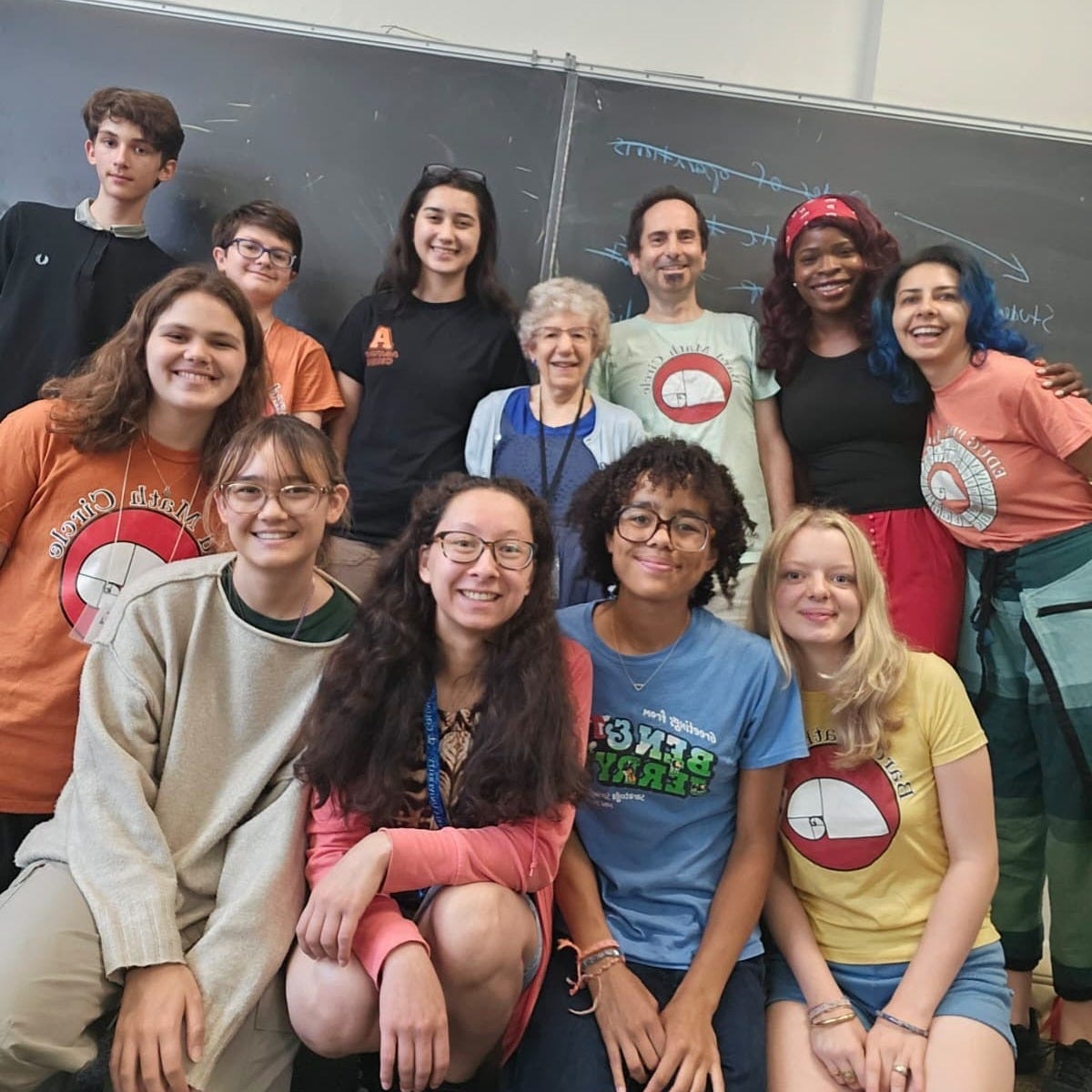
Today, our day begins with the CAMPers trickling into the art room. They resume playing the usual games, and Daniel and Maxwell even begin a group playing The Mind, where each player gets a certain amount of cards (depending on the level) and they have to place down the cards from lowest to highest without communication. Multiple CAMPers continue working on yesterday’s puzzle and even collaborate with others to get the correct answer— 21298.


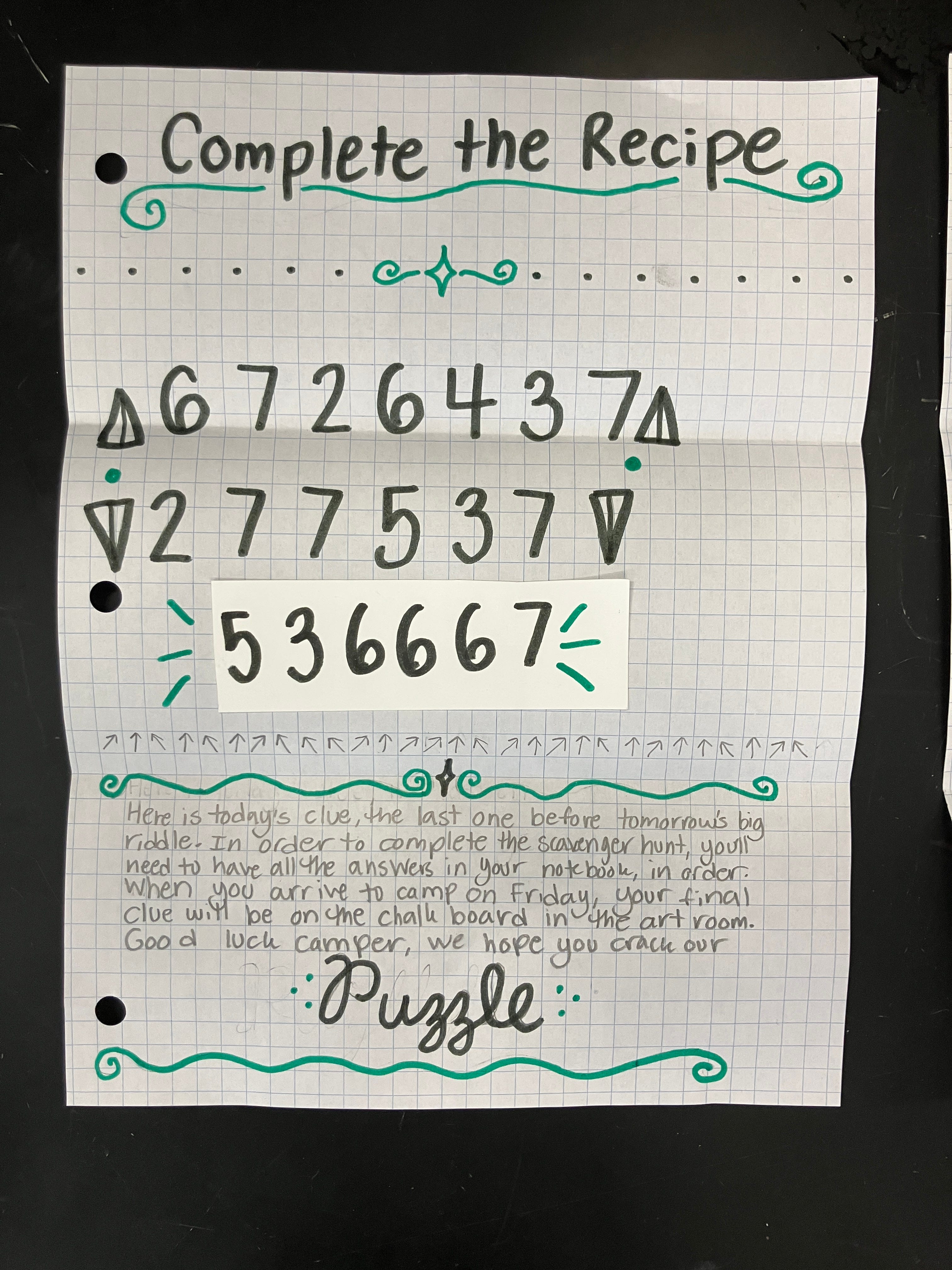
Most of the ciphers covered during this week have been common and relevant ciphers to kids interested in cryptography now. However, many ciphers are now outdated, using previously revolutionary technology no longer as common or as tough to decode. One such cipher is the telephone dial cipher. It uses the numbers around the rotary phone’s dial, where you’d rotate the dial to each number manually instead of typing it or punching it into a keypad. This cipher used those numbers to represent letters. For example, 2 would be the letters A, B, and C. 3 would represent D, E, F, and so on. Since Q and X/Z were deemed the most uncommon letters, they were grouped into a collection of 4 (7=P/Q/R/S, 9=W/X/Y/Z). These numbers and letters actually appear on some models of smartphones with a numbered keypad to enter in passwords! But how does one determine which letter the numbers correspond to? Well, usually the encrypter includes arrows that go with each number that point to one of three directions: up left, straight up, and up right. In some harder ciphers, the arrows are abandoned altogether, and the decoder must use their knowledge of English words and orthography to determine what the hidden message is.
The CAMPers head off to math, excited to continue learning about modular arithmetic. They learn the official definition of two numbers being congruent mod 26— their difference is a multiple of 26. They are encrypting and decrypting with multiplication ciphers. Yesterday, they began with this type of encryption and its introduction into modular arithmetic. Maya’s ciphertext has a x3 encryption, and the CAMPers figure out that it can be reversed by multiplying the ciphertext by 9. This meant that multiplying by 9 undid multiplying by 3; they are reciprocals, or multiplicative inverses. Then the CAMPers begin experimenting with inverses, two numbers able to be multiplied together to make 1 (mod 26). Some numbers (residues) modulo 26, like 2, have no reciprocal and are “bad”.


After creating a table with every “good” modulo — a moduli that is less than but has no factor in common with 26 (besides 1) — they playfully collaborate to fill in the multiplication table for the “good” residues by having each CAMPer get one of the “good” residues. They walk around, find another CAMPer and multiply their numbers together, take the result mod 26, then add it to the table. By the end, the table is complete, and the CAMPers are tasked with naming patterns. One of the patterns is that each of the “good” moduli appear once per row and column, including 1. They focus on 1, as multiplying to 1 means that you can undo a multiplication cipher because multiplying by 1 means the ciphertext is the cleartext. The CAMPers experiment a bit more with multiplication ciphers, especially the decryption, before the period ends.


Tangent goes to computer science and begins the day with another review session. Then they dive into lists, which are very similar to strings. You can index through both, check whether certain indexes match a certain character (or in the case of lists, a certain data type or value), and more. The main difference is that lists are mutable, meaning you can change the value of indexes. Strings, however, are immutable, meaning you can only cut the ends off or join two strings together. The CAMPers begin to code a program that uses the difference between the index position and the value at the index.


Cotangent starts the period by working on their projects from yesterday. Some CAMPers finish earlier, and they start on the project for today— creating their own cipher, drawing an object from around them, then encrypting a phrase relating to the object in their drawing. They wrap up the day by discussing and decoding each other’s projects.


Most of the CAMPers enjoy lunch outside, though a few stay inside with the air conditioning. Daniel runs a group playing The Mind, which draws the attention of other groups, and CAMPers come over to investigate.


One group heads off with Daniel and Maxwell to play quantum games. Daniel explains quantum chopsticks (where you choose whether you want to split or tap, and your opponent chooses how you split/tap), quantum tic-tac-toe (where every move you place two symbols connected by a string. As soon as a loop is created, the player who didn’t create the loop gets to choose which direction the loop goes, and with that, which squares end up as an X or an O), and Maxwell explains quantum hangman (where you have two possible words until you guess enough letters that the words cannot be the same word, then you choose one word to continue playing with). The CAMPers split up, and by the end there are groups playing many different quantum games.


Another group heads up with Makayla and Ada to make morse code bracelets. Makayla teaches them how to use knots to create the pattern of dots and dashes, with a handy morse code translation sheet to encrypt the messages. The CAMPers pick their own colors and begin knotting, requesting songs to fill the peaceful silence.


The final few follow Gemma to do paper puzzles, like Star Battle, where two stars have to be placed in each row, column, and bolded area. Gemma explains how to play, and they split up to play the different puzzles. It’s silent, peaceful. The kids enjoy their time playing the games together.


Cotangent in computer science begins the period by reviewing everything they learned yesterday, including Booleans and the abs() function. They then began to use these topics in their own code. They define a function that takes in three arguments— integers “val1” and “val2”, and the Boolean “neg”. If the value of “neg” is equal to True, then both “val1” and “val2” have to be negative numbers for the function to output the value True. If “neg” is False, then one of the numbers has to be negative and the other has to be positive for the function to return True. The CAMPers work through the problem in their programming-pairs, writing their functions and testing them until class ends.


Tangent gets their chance to finish their projects from yesterday and begin on the one for today. The CAMPers dive right in, chatting with those around them to fill up the silence as they work. They create their own unique encryption systems and create a key on a separate piece of paper to document the code. The artworks end up colorful as always, and full of hidden messages.


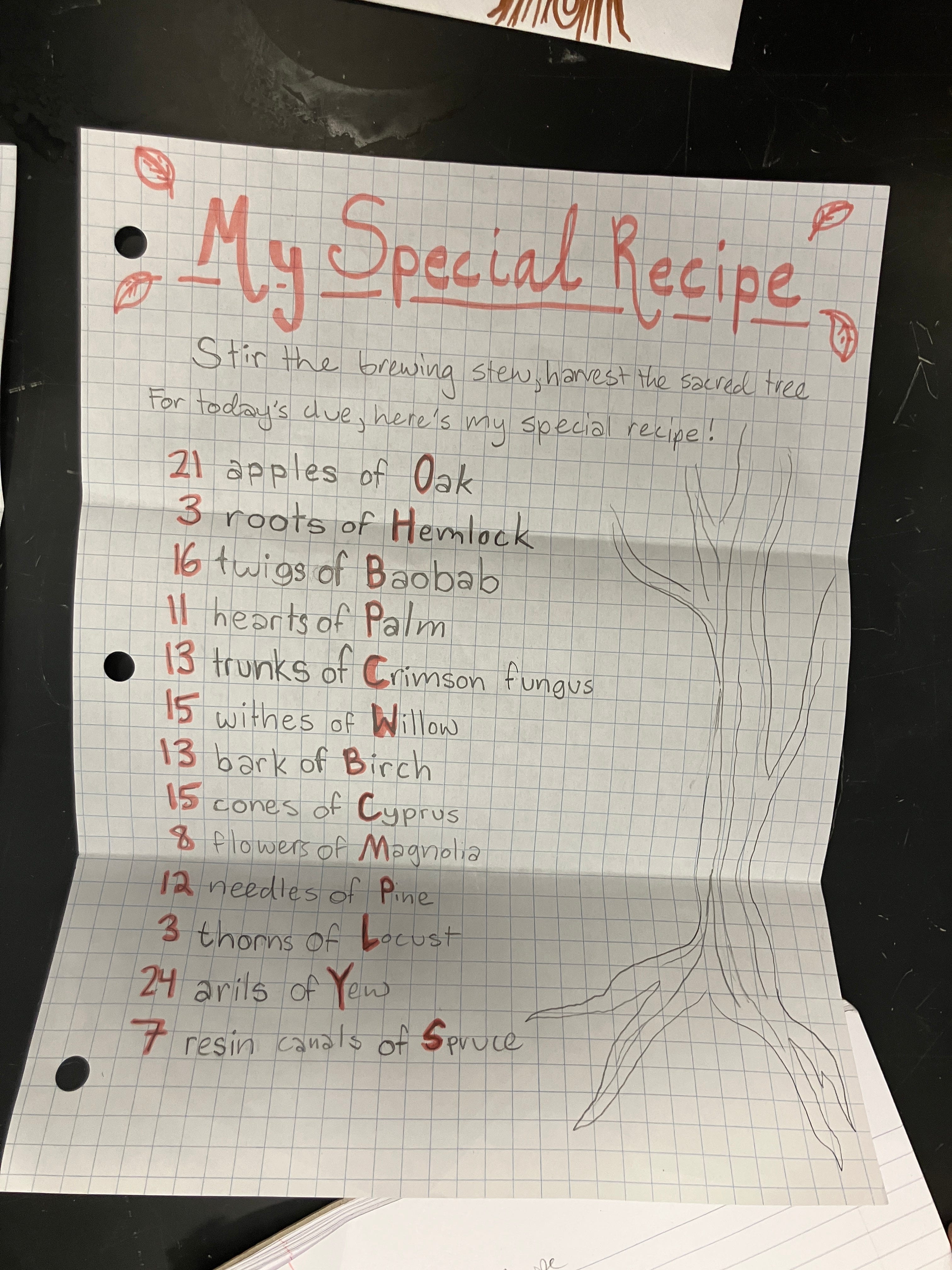
After their last class, the CAMPers resume playing their games. They divide into their groups until the puzzle of the day is released. A crowd of CAMPers huddle around the clue, enthusiastically copying the puzzles down to solve at home. Then some get to work on solving it, eventually cracking the first part before they are retrieved by their parents.


Today’s puzzle:


Final reminders— open house is tomorrow! Parents, make sure to come from 3:00-3:30 to see the CAMPers’ work. It has been so much fun with all of you CAMPers. We can’t wait to round it out with another amazing day tomorrow.