

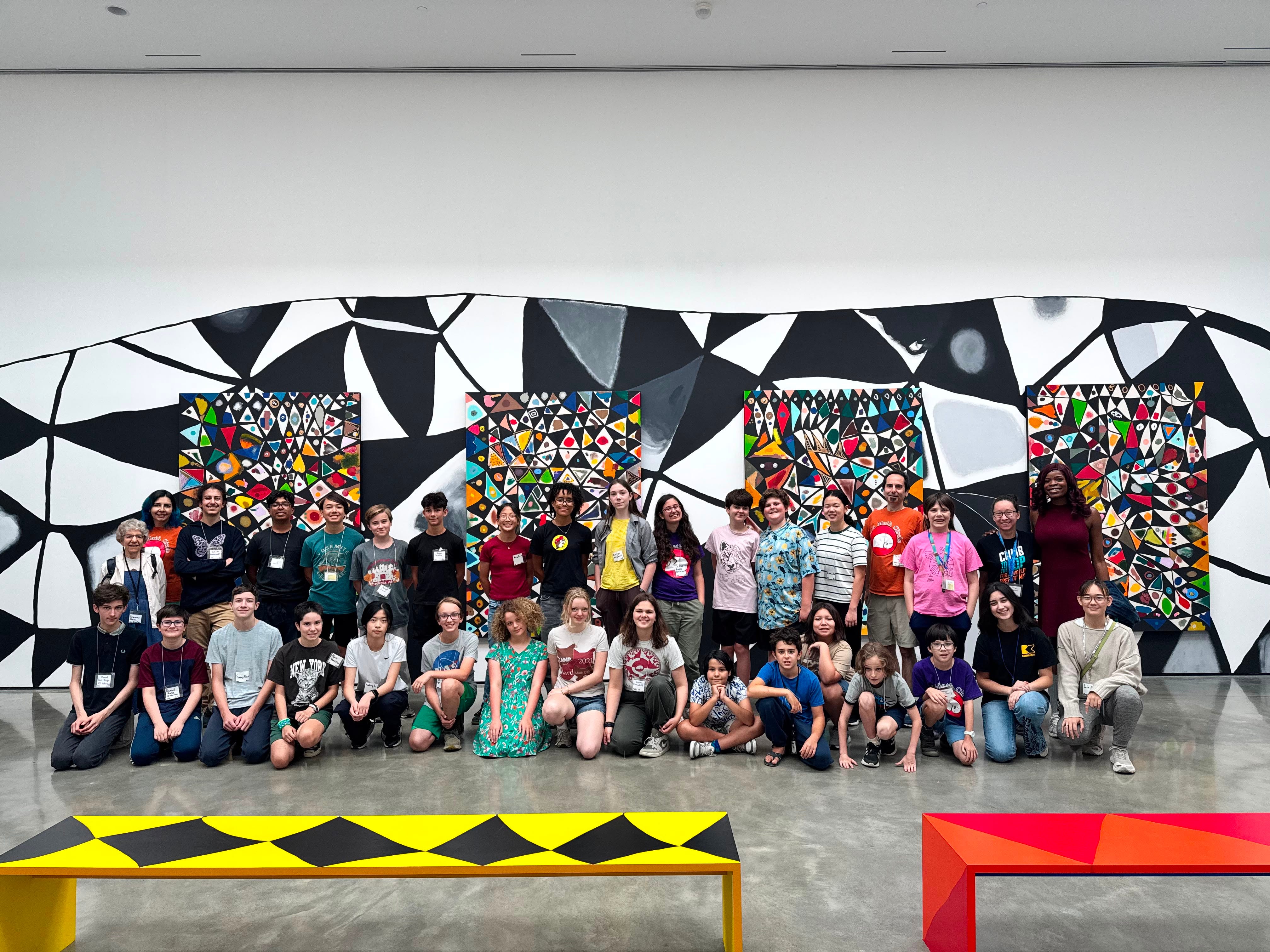
In the morning, the CAMPers slowly trickle in and join their usual groups. They are actively collaborating on many of the same games they have played throughout the week, strengthening their understanding of the rules and patterns. Makayla and Ada direct their attention to yesterday’s puzzle, which only a few kids ended up solving all the way. A poll commences, but the CAMPers decide that the difficulty of today’s puzzle stays at a similar level. Then the group shares the answer— VI and/or VII, or 6/7.


Today, there is a lot of work with modular arithmetic, continuing from yesterday. We actually use modular arithmatic in our daily lives a lot! One of the most common instances is telling the time. In the USA, it is standard to use the AM/PM system instead of the 24-hour clock. This means we use mod 12 to determine the afternoon times— for example, if it was 7am and you wanted to know the time in 7 hours, your answer would be 2pm, not 14:00. We also use it for most of our calendar system, though we use day and month names to disguise the math!
Then the math classes split again. The CAMPers discuss which shifts end up giving the same encryption. Modular arithmetic is the hidden key that relates all of these shifts— if the shifts are equal in mod 26, then they will result in the same encryption. Then the class moves on to a new but similar system, where instead of adding a certain number for the shift they multiply by a number. So “a”, which would be a shift of zero, is multiplied by 3 (to equal 0, no shift), and “b” which is a shift of one would end up being a shift of 1*3 or 3, and so on.


This leads into the discussion of which numbers allow for every letter to have their unique character in cipher text. Again, it relates to 26: if the shift is by 0 or any factor or multiple of 26, there will be multiple translations to cleartext for the same ciphertext character. There is a little review of modular arithmetic from yesterday, including how to find the gcf (greatest common factor) and the correct notation. Then the topic of inverses comes up under the guise of easily finding which cleartext character matches the given ciphertext character.


Tangent begins the class period with going over everything they learned yesterday. The CAMPers are eager to dive right in with strings again, learning about concatenation and adding “not” to the beginning of other strings after checking whether it already has one. They spend more time playing around with the properties of strings by using indexing. Their next task is to write a program that switches the first and last letters of a word. For example, the word “coding” would end up as “godinc”.


In art with Layo, Cotangent reviews their creations from yesterday, and they spend the beginning part of class discussing and decoding together. Then they begin the project for today— to create an abstract art with an encoded message of symbols. Each letter is a grouping of two shapes (circles, squares, diamonds, hearts, etc). The CAMPers spend the rest of class designing their messages and artwork in a way to weave them both together.


The CAMPers divide up into similar groups as yesterday, enjoying spending the time outside. Lunch today is cut short because of our elective: heading out to the Hessel Museum!


After the short walk to the museum, the CAMPers listen intently as one of the workers explains about the history of the museum and the artists’ exhibits within. Our very own Layo knows one of the artists, so she is our tour guide for the day. There is a short detour to drop off bags before they head over to Uman’s exhibit. We see Uman’s kiosk that she decorated and used to sell her other artworks off of.


“It has a lot of meaning, if you take the time to look.”
At the very end, we pass through Marilou Schultz’s art exhibition but don’t have time to go into much detail. The CAMPers adore the tapestry of a working QR code. If you’re around the area, definitely come check it out!


Cotangent starts with reviewing the python terminal commands from yesterday, with Fidan trying her hand at teaching her first class! The topic of functions is brought up, relating it to mathematical functions to make a stronger foundation. The CAMPers get introduced to the abs() function and try different inputs until they discover that it takes the absolute value of the number entered. After that, they dive right into Booleans and how to assign them to variables. The CAMPers learn that the Boolean “True” has a value of 1 and the Boolean “False” has a value of 0 because computers think in binary. They write functions using Booleans and abs(), as well as the “return” statement to have the function output a certain value.


Joining Layo in the art room are all of the Tangent CAMPers. They sit down and discuss the art they saw previously at the museum, as well as how to incorporate similar abstract designs into their own pieces. The CAMPers quickly begin on their own works, getting a rough sketch down on a smaller piece of paper before working on their final project. Using the same code of two symbols, they design their artworks around their secret code.


The CAMPers split again today for the fraction workshops! One group follows Gemma to review more about fractions before beginning on another one of the hard problems from the application set. The CAMPers attack the problem vigorously and learn a lot. Then the problem of the day is given, and all focus turns to that.


The other group goes with Frances to learn about set theory and the Calkin-Wilf tree, which is a mathematical model of every rational number. It works by having every left branch of the fraction a/b convert to a/(a+b) and every right branch become (a+b)/b. The CAMPers are on the edge of their seats the entire time, wanting to learn more about the different applications of fractions. They are left with the question: “Are any rational numbers repeated, and are any numbers skipped? (And how do we prove it?)”


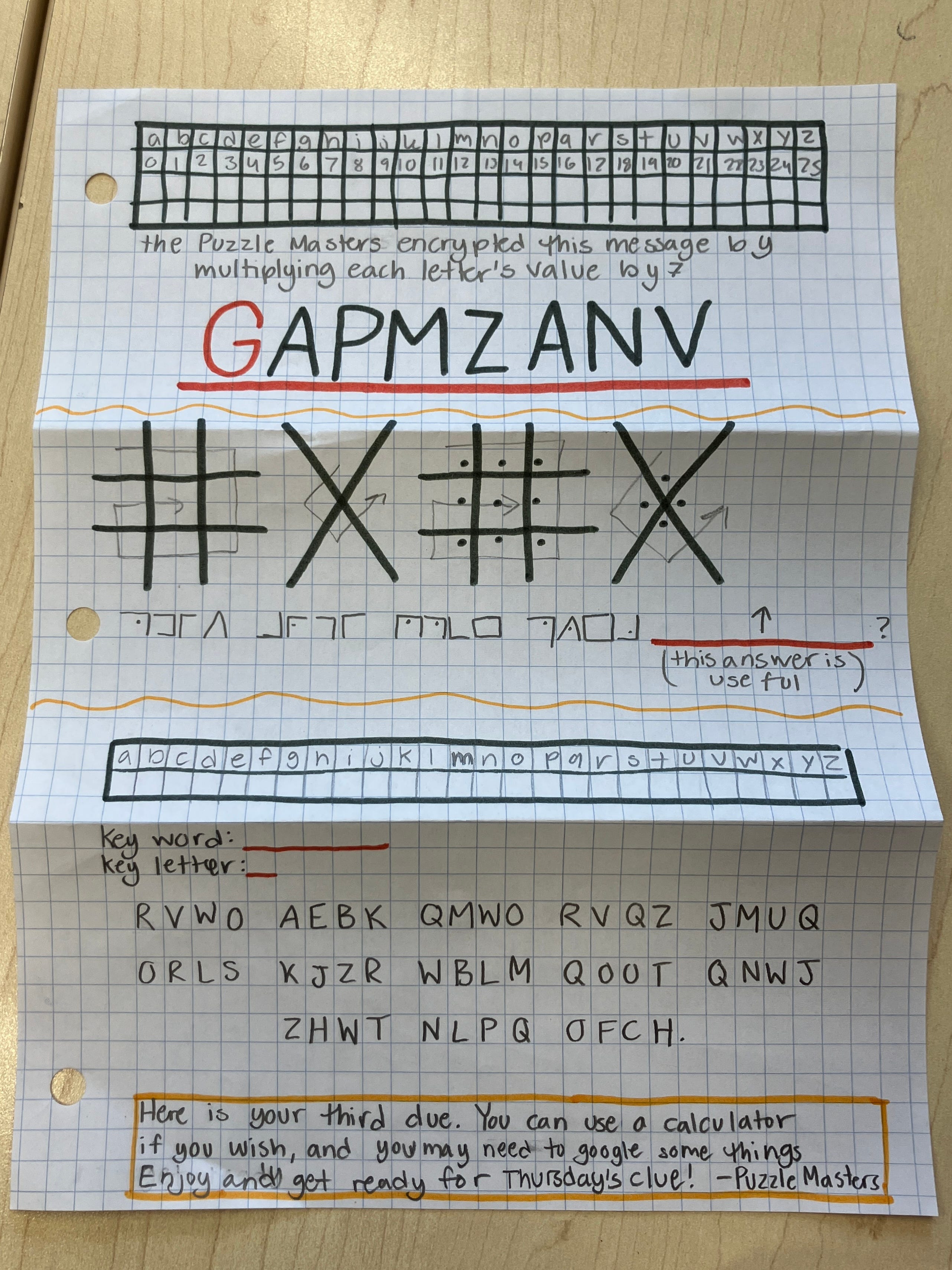
And today’s riddle:
There will be no more fraction workshops tomorrow, so pickup time is back to 3:00-3:30. And a reminder for Friday— our open house is held from 3:00-3:30 so, parents, come and see your children’s work!