

Today, we begin by meeting in the art room for our morning games. We have big groups working together on set and chess, as well as smaller groups playing with the car parking puzzle, cards, and more. A CAMPer explains their solution to yesterday’s riddle (“dozens”) and decodes the cipher to give us the answer 8089, and many other students nod in agreement.


A big focus today is on the Vigenère cipher, misattributed to French mathematician Blaise de Vigenère where the cipher got its name. However, the tabula recta (a giant table consisting of every Caesar cipher for every letter in the English alphabet) that this cipher uses was first created by Johannes Trithemius. He used it to create what is now known as the Trithemius cipher: the first letter of the plaintext is shifted by 1, then the second is shifted by 2, then 3, etc. The Vigenère cipher is based on that same tabula recta but with a keyword instead to make it harder to decrypt.
The group divides back into Cosecant and Secant for the CAMPers’ second day of math! Cosecant follows Maya and begins the day cracking ciphers. Secant does the same, after a quick name challenge to see whether they can name all of their classmates. The focus today is on substitution ciphers like the Caesar cipher touched on yesterday, as well as the new keyword and Vigenère ciphers. They discuss different clues used to crack the codes if the key isn’t known, like a frequency analysis to see which letters are more common (like E, T, A, I, O, N, S, etc in English).


Similarly, there are common two-letter combinations that appear more often than others — th, sh, cr, ck, ee, ea, etc. These types of clues are present in Caesar ciphers, but also in cryptoquip puzzles where the letters of the alphabet are scrambled then swapped out. The CAMPers are especially interested when the topic of modular arithmetic comes up, as it is new for a majority of them. The class spends the rest of their class time learning about how modular arithmetic works, with certain numbers being congruent using different moduli.


The Tangent group reviewed everything new from yesterday, then they began an introduction to strings, which are held in quotation marks. They are presented with indexes and indexing to determine the place of different characters in the string, which leads to discussion of the different ways to slice and operate on strings. This leads into a lesson on lists as they have a similar sort of indexing system. The CAMPers get a few practice problems, and they work together in their pair programming duos to complete them. They end with learning about “for loops”.


Cotangent goes to the art room to begin their artwork of the day. There is a quick lesson about the pigpen cipher before the CAMPers get to work. The goal for the day is to create a cardboard construct covered in color, with an encrypted message relating to the shape added on top. The CAMPers work very diligently and end up creating very creative and colorful designs!


The weather permits us to leave the confines of the building, so everyone heads outside for lunch. A few big groups form, and the rest of the CAMPers spend more one-on-one time chatting with the staff or each other.


The CAMPers split into three groups for their elective period. A group goes out with Japheth and Maya to the waterfall. They get close to one waterfall but don’t want to get too close and disturb the other people peacefully viewing, so they continue further. The CAMPers enjoy stopping by the creek and skipping stones, and they make it to the peace garden before finally turning around to head back.


The next group goes inside with Frances and Daniel to learn magic tricks. They learn a trick based on the properties of the number nine and another based on base three. After a bit of a struggle through long subtraction without a calculator, the CAMPers are delighted to figure out that many unique tricks work through the properties of mathematics. Daniel amuses them with a card trick using sleight of hand, and there’s not enough time for Frances to deliver a card trick— hopefully Thursday!


The last of the CAMPers head outside with Gemma, Makayla, and Ada to play lawn games. They play a round of capture the bag that ends with a crazy 4v1. Then they transition to the game “Why were you late?” where a boss attempts to interrogate their worker while everyone else mimes the craziest stories for the worker to repeat. With lots of laughter and mistranslation of mimes, they play a few rounds before it is time to head back.


The Cotangent group starts out in computer science with a review of yesterday. They discuss how to access python 3 via the Mac terminal as well as the syntax. The CAMPers are all interested and chiming in especially as they learn about new commands and the difference between operands (numbers, variables, etc) and operators (the operation being performed, like addition, subtraction, multiplication, etc). With this, they discover that variables and comparison operators (=, <, >) appear in both computer science and math. As they play around with the terminal system, unable to use the Internet to help them, the CAMPers learn numerous skills on trial and error until results appear.


Tangent CAMPers get their chance to build their own cardboard creation. Their class is focused, building intricate shapes and decorating them colorfully as instructed. At the very end, they stick on their encrypted pigpen texts and discuss what they wrote as a class.


The CAMPers split once more today, with one group heading off to discuss Fractran, a simple and Turing-complete (meaning it can solve any problem able to be computed) programming language created by John Conway—the same mathematician who made Conway’s Game of Life! They attempt to prove that 2 is a prime number, and they would have given enough time, although other proofs are a lot easier and faster to prove. They discuss other applications of Fractran, before the riddle of the day is given out in an envelope.


The other group heads to work with fractions. They review addition and converting denominators, and everyone joins in to discuss. They end the day working through one of the hardest problems on the application set together as a group, before the riddle of the day is given. The CAMPers immediately jump to begin solving, eager to continue strengthening their brains.


And here is the puzzle for today:
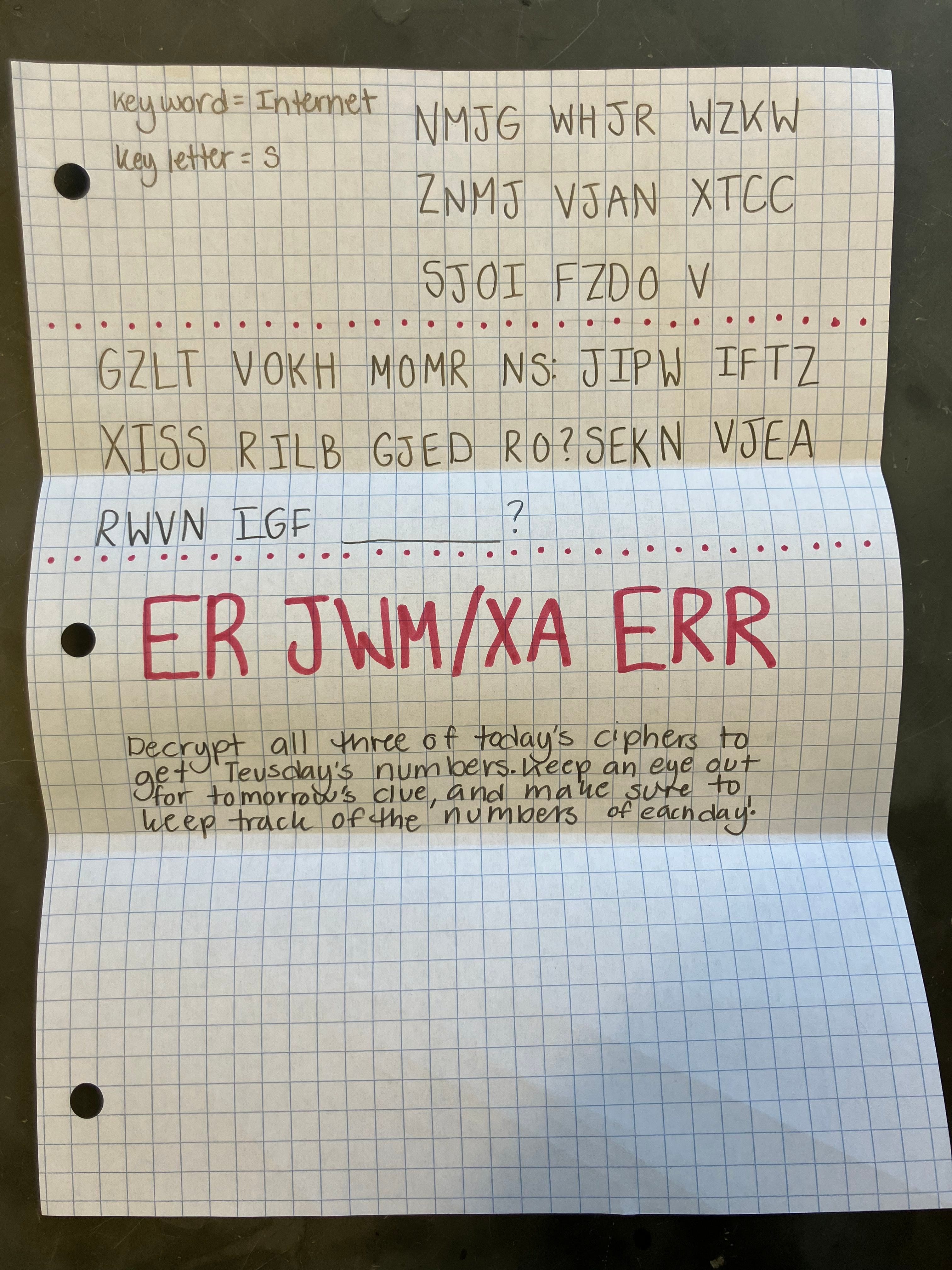
For tomorrow, there will be no split for electives as everyone will be heading to Hessel Museum (about a 10 minute walk). Lunch period will be a little bit shorter, and CAMPers—make sure to bring walking shoes, sunscreen, a hat, and anything else for the walk. Also, open house will be held this Friday from 3:00-3:30. Parents, make sure to set aside time to see the CAMPers’ amazing work!