

For the past few weeks, Bard CAMP has been undergoing a migration to Substack! All of our previous posts are in the process of being moved, but the blogs for this week will be released on Substack only, not Wordpress. We will be working through this as fast as possible; however, not all pages have been moved yet. Please be patient!
Hiding messages using code has been useful for many years. One of the more famous examples is Julius Caesar, who used what is now called the Caesar cipher to send secure communication around the Roman Empire. The Caesar cipher is a classical substitution cipher that encrypts a plaintext message by replacing each letter with another letter shifted a fixed number of positions forward or backward in the alphabet. This week, the CAMPers will be learning about various codes and cipher systems, the processes of encryption and decryption, the mathematics behind these ciphers, and their uses in art and computer science.
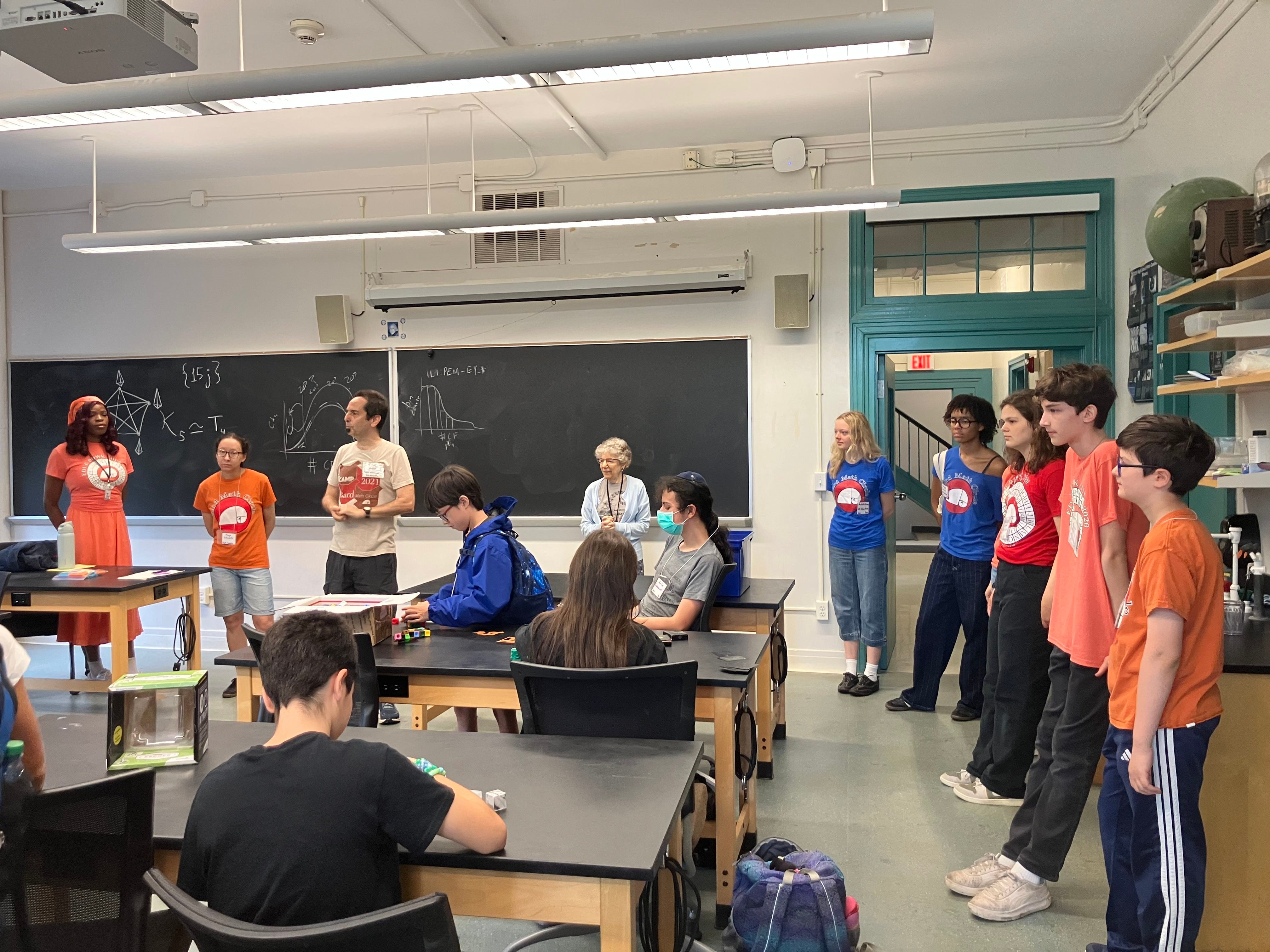
The CAMPers start off the day in the art room, working on different games and puzzles to get their brains warmed up. The room is quickly abuzz with smaller groups working together on set, wooden and metal puzzles, tangrams, car parking puzzles, and more. We introduce our whole staff team after the CAMPers wrap up the activities.


Then the CAMPers split into two groups for math: Cosecant with Maya and Gemma, and Secant with Japheth. Both classes learn about four different transposition ciphers: backwards writing, railfence cipher, twisted path cipher, and scrambling with a key word; as well as the difference between ciphertext, which is conventionally in uppercase, and plaintext, which is usually lowercase.


The students also learn an important lesson about going outside on Bard campus— skcitdnayvinosioproftuohctaw (watch out for poison ivy and ticks, if read backwards). Then they shift to using these ciphers to encrypt their own messages, and the period ends with learning about Caesar ciphers.


The CAMPers leave the class wondering “What if we don’t know the shift or key?”
Again, the CAMPers split into two groups, with the Tangent group heading to computer science with Yulia and Cotangent to art with Layo.
In computer science with Yulia, the CAMPers participate in an icebreaker to get to know each other’s names, favorite snack, and goals for the week— to learn ciphers, more about Python, and have fun! They review what they already know about Python commands like Boolean and logical operations, arithmetic operators, print vs return statements, and how to create variables and functions. Then they use a pair programming system, where one student types and the other instructs what to type, to test their hand at coding. They work in these groups to create a function to determine whether a number is “close” (within 10 of) 100 and 200. It is stressed to condense and simplify their code if possible once it works, with the most optimal solution using only one line. After that, their next prompt is to write a procedure called xor(), which takes in two values and returns True if only one of them is True.


In art with Cotangent, Layo explains different ways of including text and symbols in art, displaying examples up on the board for the CAMPers to see. They are then tasked with creating their own message to encrypt by a Caesar cipher. As it is a secret message, they keep their shifts and plaintext to themselves. The next task is to create a drawing that includes the encrypted text, the number of the Caesar cipher shift, as well as the direction. The CAMPers accomplish this using the various methods discussed earlier in class, and it is a great way for them to let their creativity run loose.


Both of the groups join together for lunch inside, as the campus outside is a little too wet for comfort. Even still, there are many different groups of CAMPers talking with both each other and the staff.
Today’s electives are word puzzles with Makayla and Ada, as well as board games led by Maxwell and Daniel. The CAMPers get experience with numerous board games and vocal puzzles to test critical thinking and attention to detail. Both rooms are full of aha-moments and fun.


Once electives are finished, CAMPers get back into their Cotangent and Tangent groups to switch for the final class period. Cotangent heads to computer science, where they do introductions and discuss the differences in dealing with a human versus a robot. They discuss the importance of being detailed and specific, as the computer does not understand instructions like “make a PB&J” that other humans do. Then they split up into pairs and discuss pair programming, but the class ends before they have the chance to actually experience it.


Tangent heads to art in order to explore the more creative side of ciphers. They learn about different methods of hiding text in their artworks: overlapping text, crossed out, or adding a mirroring effect. Then they create their own piece with a hidden message of their choosing and end the class off by discussing the different clues in their artworks that tell the shift and direction.


Both groups meet back in the art room to resume their morning games, as well as a new cryptography puzzle that draws in a large group of CAMPers eager to use their new cipher-cracking techniques! Many CAMPers were sad to leave, but we are excited for the day to begin tomorrow!


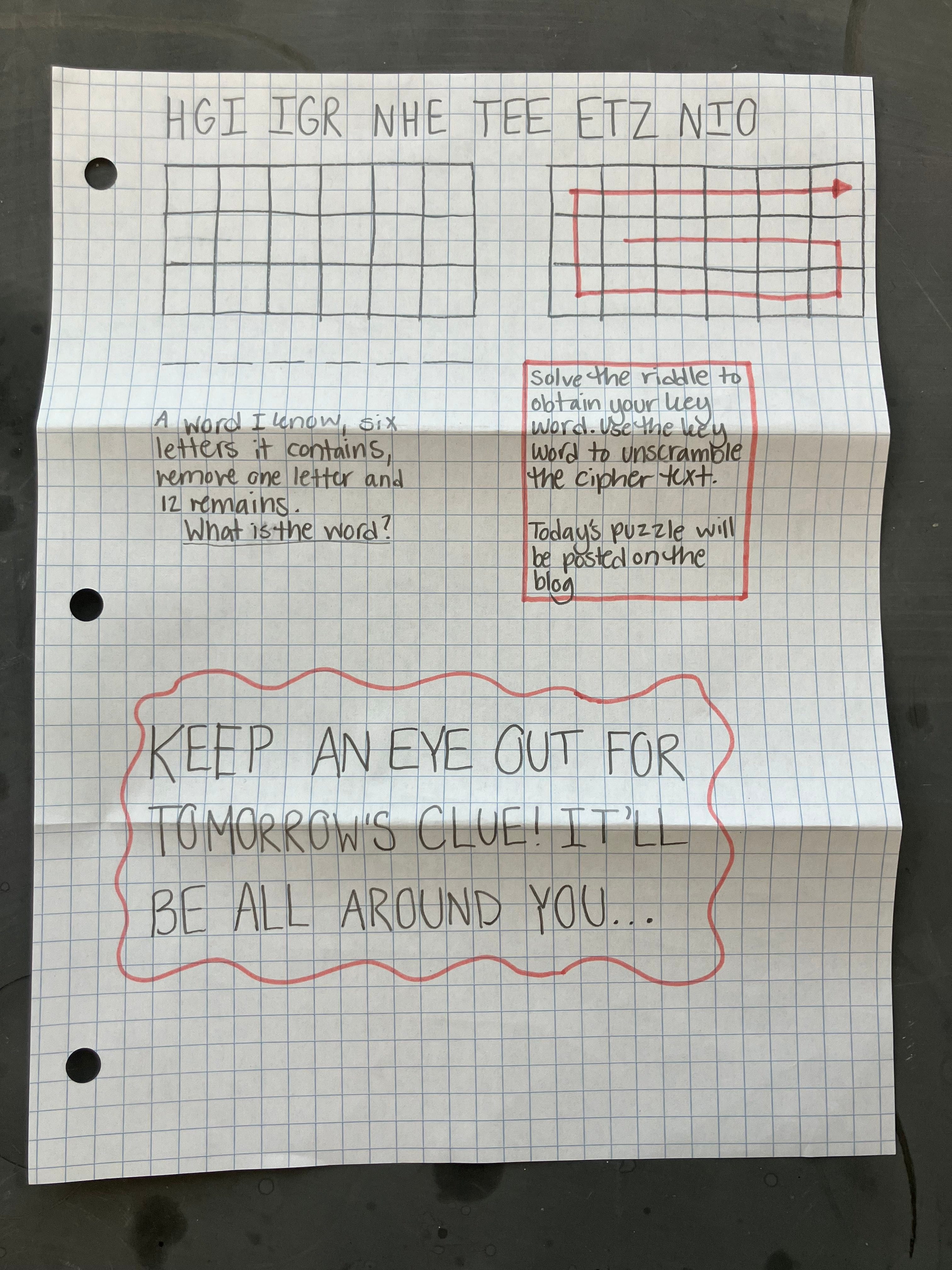
And, as promised, here is today’s puzzle:
A quick reminder about tomorrow and Wednesday— there will be a fractions workshop at the end of both days, so pickup will be closer to 3:25-3:30. Can’t wait to continue the rest of the week with the CAMPers!